Default Currency
From Mountain to Mantle: The Journey of a Himalayan Salt Lamp

A Himalayan salt lamp begins long before an artisan reaches for a saw or drill. Its raw material is rock salt—halite: formed from an ancient body of water, buried, compressed, uplifted and eventually exposed within Pakistan’s Salt Range. What arrives in a home as a softly glowing object has already passed through geology, underground mining, material selection and a surprisingly hands-on finishing process.
Where the Salt Actually Comes From
The name “Himalayan salt” can suggest that the material is cut directly from the high, snow-covered Himalayas. In practice, much of the pink rock salt used for lamps comes from the Salt Range of Punjab, Pakistan, a separate range lying south of the greater Himalayan system.
The geology is far older than the lamp trade. According to UNESCO’s description of the Salt Range and Khewra Salt Mine, the region traces its origin to the evaporation of a shallow sea roughly 800 million years ago. Thick salt deposits were later caught up in the tectonic forces that shaped the region, leaving substantial seams of rock salt within the hills.
Khewra, in Jhelum District, is the best-known mining center, but it is not the only important source. The Pakistan Mineral Development Corporation identifies rock-salt operations at Khewra, Warcha and Kalabagh. Khewra’s long mining history and large deposits, however, have made its name especially closely associated with the pink salt sold internationally.

From Underground Seam to Workable Block
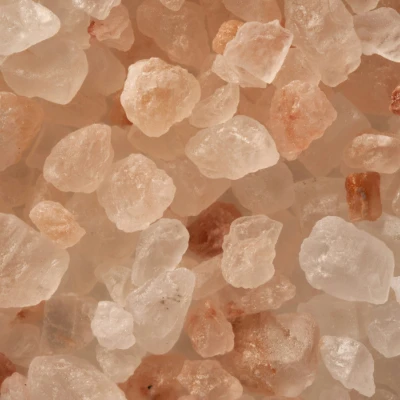
Salt intended for decorative products does not leave the mine looking anything like a lamp. It comes out as irregular masses and blocks that can vary considerably in color, translucency, veining and structural integrity.
A block destined for carving must be large enough for the intended form and sound enough to survive cutting, drilling and finishing. Fractures that may be irrelevant when salt is crushed for other uses can become decisive when the goal is a solid decorative object.
The familiar range from pale peach to deep orange-pink is part of the appeal. Artists do not need to manufacture a pattern into the material; mineral variations and natural seams already give each block its own appearance. The craft begins with deciding how much of that original surface and shape to preserve.
In a sense, every lamp begins as a geological sample: color bands, veining and cloudy zones are all records of the ancient sea and the conditions under which the salt was laid down.
The Artisan’s First Decision: Natural or Sculpted?
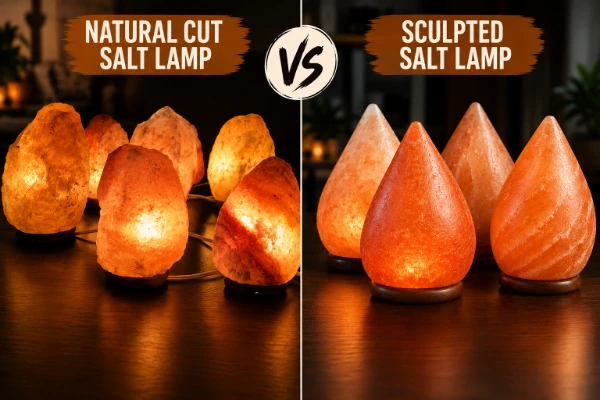
The classic natural-cut lamp deliberately keeps much of the rock’s broken, irregular exterior. The block is trimmed to a stable proportion, a flat bottom is established and weak or unwanted projections are removed without erasing the raw character of the salt.
More formal lamps require additional shaping. Blocks may be cut and ground into spheres, pyramids, cylinders, teardrops or other decorative forms. The work resembles stone carving, but salt demands control: removing too much material, striking a hidden fracture or applying uneven pressure can ruin a piece that has already traveled from mine to workshop.
This is where a lamp stops being simply a chunk of salt. Proportion, balance and surface treatment determine whether the finished object feels deliberate.
Making Room for the Light
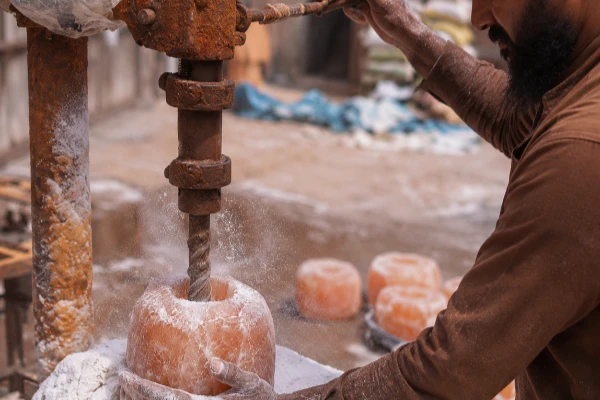
Once the exterior form is established, the lamp has to be engineered from the inside. A cavity is drilled or bored into the base of the salt so that a small light source can sit within the block. The opening must be deep and centered enough to illuminate the salt effectively without weakening the walls around it.
The base is then fitted, commonly in wood, along with the lamp’s electrical components. On a natural-cut piece, that base also has another job: it gives an irregular rock a stable footprint.
Final finishing depends on the design. A rough lamp may receive only selective smoothing around its base and opening, while sculpted pieces can be progressively ground and polished to emphasize their geometry. Edges are checked, loose material is removed and the lamp is inspected for cracks that could affect durability.
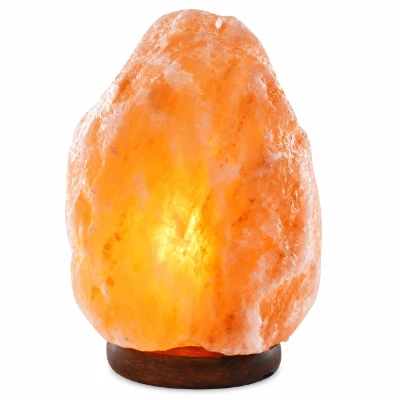
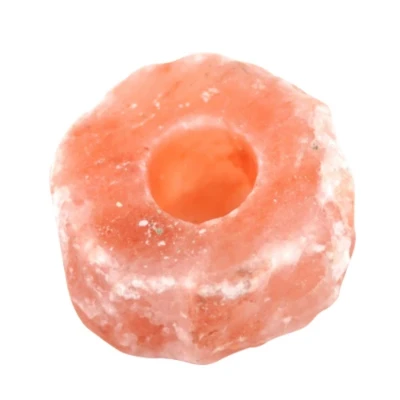
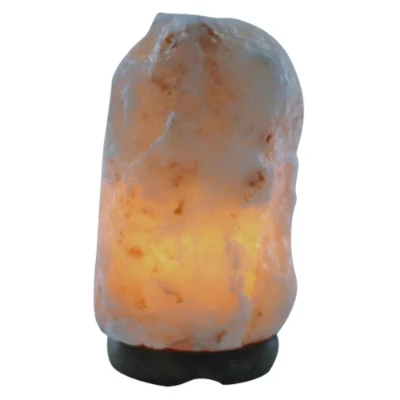
Our current collection of Himalayan salt lamps shows the contrast clearly: even within the same basic product category, natural contours, weight, mineral veins and color make individual pieces visibly different.
From Workshop to Home
Each finished lamp is wired, tested and packed to protect its fragile mineral surface before it ever reaches a mantle, bedside table or shelf.Explore Salt Lamp Styles
What the Finished Lamp Still Reveals
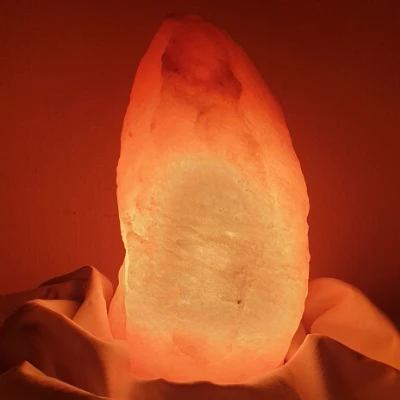
The most interesting part of a Himalayan salt lamp is that the manufacturing process never completely hides the source material. A ceramic lamp is shaped from a pliable body before firing; a metal lamp can be stamped, cast or machined to close tolerances. A salt lamp remains recognizably geological.
Its cloudy sections, translucent bands, fissures and shifts in color are not surface decoration applied at the end. They are evidence of the deposit from which the block was taken. The artisan’s job is largely to work with those characteristics rather than eliminate them.
That is what connects the mine to the mantle. The lamp is both a functional lighting object and a finished piece of mineral material whose origin remains visible. Its journey is not simply extraction followed by manufacturing; it is a sequence of choices about which natural qualities to preserve, which surfaces to refine and how to introduce light without losing the identity of the stone.
By the time a salt lamp reaches a shelf, bedside table or fireplace mantle, millions of years of geology have been condensed into a relatively simple object: a mined block, selected for character, shaped by hand and illuminated from within.
Explore Different Lamps Available for Purchase